THE BEST PLACE FOR AND VACATION!!!!!!!!
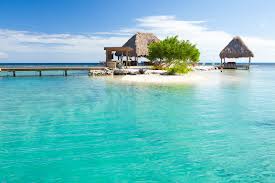
  | About UsYour comfort is our goal. We have created a restful retreat that you can think of as your home away from home when you’re in the area. We offer services for any traveler, whether you’re on business or your journey is for pleasure. When you plan your visit, consider us for your stay. Roatan Island Honduras is an adventure traveler's vacation paradise in the Caribbean. Roatan with blue skies, sun drenched clear turquoise water, and year round temperatures in the high 70s and low 80s. Roatan Island lies 30 miles off the north coast of Honduras and is 33 miles long and 4 miles wide. You won't find four star high-rise hotels, yet, but you will find a new golf course (Pristine Bay) which is closed to the public, and several limited shopping malls. You will find Roatan struggling with tourism, real estate development, and infrastructure support such as transportation, water, sewer, and power. Roatan has improved trash removal. Don't be surprised to find pristine areas next to unkempt property. Roatan Island does offer first class scuba diving, scuba certification, outstanding snorkeling, water activities including deep sea fishing, fly-fishing on the flats and mangroves, swimming with the dolphins, and ocean kayaking and jet ski rental Land activities include a choice of canopy tours, riding horses, exploring lush tropical scenery, shopping for island crafts, eating at some of the best restaurants in Honduras, walking the beach and viewing the butterfly and floral gardens. The island has full service resorts and small, personal low-key resorts or you can rent a private home. Our RoomsWe are conveniently located, and our rooms feature beautiful décor and all the amenities you could need. We have made it easy and safe to reserve and pay online - contact us now! |
Tourist Publications for Roatan Island
There are several free publications that the tourist traveler will want to pick up soon as you arrive in Roatan. The first is Honduras Tips which is readily available from most resorts and hotels. In this publication, you will see "Tips" on Roatan and all of Honduras. This is published quarterly and is considered the "The Official Travel Guide of Honduras". Generally speaking, this is "relatively" current and has maps, descriptions of restaurants, etc. Keep in mind this is a commercial publication that gets its revenue from selling ads. Their web site at www.hondurastips.honduras.com. It does cover the major cities in Honduras. (We are not listed in this publication since we have not purchased an ad.) You will find similar small tourist booklets at the car rental companies at the airport.
If you want the real news of the region including the main land area and the Bay Islands, then Honduras This Week is your online choice or you can purchase one for approximately 7 lemperas. This is the real news of Honduras and is published weekly.
Another excellent publication is the Bay Islands Voice. Articles on the local politics and infrastructure problems in Honduras and the Bay Islands. You can read previous issues of the Voice free on their web site www.bayislandsvoice.com. The Voice will give you the local gossip and interesting news. The Voice costs about 130 Lempiras for a hard copy on the island. You will find the Voice in the larger grocery stores.
Another publication is the "Roatan Great Location". This small free booklet contains maps, a tourist oriented telephone directory and lots of tourist information. You can find this booklet at the airport and car rental locations.
Roatan Beach
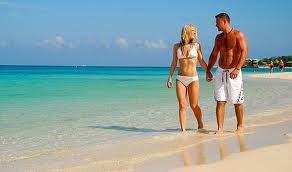
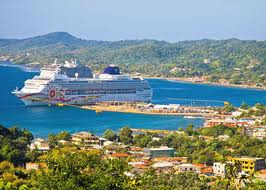
The beaches on Roatan are quite different depending upon your location on Roatan. All beaches on Roatan are supposed to be open to the public but some resorts "think" they own the beach and can make you feel unwelcome by charging $10 to 15/person to enter their property. The West Bay resorts are the worst for charging even to use their restaurants! West End however is wide open and there are no entry fees on the beach. If you really want to get to West Bay, either pay the fee or take the water taxi for a few dollars from West End and arrive at the public beach in front of the West Bay resorts. Here's a hint to enjoy West Bay and avoid the entry fee charges. Go to the San Simon Beach Clubwhich is the same area as the cruiseship tours in West Bay. They have an excellent restaurant and you can catch water taxis, the para sailing tour, or just go snorkeling. They also have a beach right next to the cruiseship beaches. The southern shore of Roatan, as a generalization, can be characterized as a volcanic rocky shore with limited water access. There are a few sandy beaches at some of the "private" resorts (you have to pay to get in .... you have to cross a small bridge with a guard) along the southern shore. The western and northern shores of Roatan have mostly sandy beaches and a few mangrove and volcanic areas. From a tourist perspective, most tourists head to Half Moon Bay, West Bay, West End and the many less crowded beaches along the northern shore line. Tabyana Beach Resort and the Henry Morgan Resort in West Bay are considered the "hot spots" for cruise ship passengers. Half Moon Bay is the second hot spot for the cruise ship passengers. The beaches in the West Bay area offer beautiful sand and good snorkeling but tend to be very crowded on cruise ship days. The first two beaches below are near the Henry Morgan Resort area in West End. The pictures below are during an un crowded time of day. Expect large crowds when a cruise ship is in port.
|
|


On the other hand, there are many other readily accessible secluded beaches on Roatan. Tanya shown below found a beach without the crowds. Please note that at many of the beaches there are no services so bring your own supplies as you may be the only person there. There are many beaches along the northern coast and a taxi drivers can easily find you a remote beach. Best to "hire" the taxi for the day because when I say remote, you will need to have the taxi driver wait for you while you play and snorkel at the beach. Expect to pay about $100 to hire the taxi (price for typically up to 4 people) for the day tour. You can explore on your own and easily find an un crowded beach. Please be mindful of using public access to get to the beach and taking your trash with you.
|

Snorkeling in West Bay can be difficult if you are not a good snorkeler. You may find the best snorkeling in approximately 25 to 30 ft of water just on the other side of the shallow coral heads and formations. Be careful not to touch the coral as you find you way to the deeper water where you will find a good variety of sea life. If you want to get away from the crowds, you could seek out one of the many tour boats for a snorkel trip to a less crowded beach. One tour operator that specializes in small groups is Crystal Beach Cabins.
You can find more maps in greater details in the locator maps on this web site. Resort beaches are easily accessed from Lawson's Rock to Anthony's Key and from Half Moon Bay to West Bay. You should contact the resorts directly to see what services are available. There may be costs associated with using their facilities and you will need to hire a taxi or take the bus to the resort. Water taxis are readily available in the area from West End to West Bay to visit the crowds. You will want to check the costs of taxis land and sea on this link.

 |
will find the larger stores well supplied and many products from the US.Tourists might check the small local stores for some local items to snack on whilethey are touring. Besides the obvious cold drinks, there are products like plantain or banana chips that might spark your taste.
Roatan has a variety of grocery stores ranging from modern to basic. Above are a few of the smaller stores. The most notable and largest stores are Plaza Mar near the airport,Eldon's (Sun Grocery Store) in French Harbour and Coxen Hole , the Hiper Mega in the Mega Plaza Grocery, and Warren's (now owned by Eldon) in Coxen Hole. Eldon's (two locations now) in French Harbor and just behind the Bojangles in Coxen Hole has the best selection of groceries and other items. A small grocery store is Woody's in West End.
The local residents will use the "Mercado" in Coxen Hole and one of the many "pulperias" scattered around the island. The Mercado Municipal is an open air and stall building complex with vegetables, meats, and household items in the residential center of Coxen Hole. Additionally, there are several fish vendors along the street in Coxen Hole.
In the residential areas, there are vegetable and fish vendors that will drive through the neighborhood with a pick up truck loaded with fresh fish and mainland, vegetables and fruits. As of 2010, most of these vendors now park on the sand road in West End and sell their produce. Usually, there are 5 or 6 pickup trucks with loaded with fresh vegetables. Bread and tortillas are made on the island.
Don't expect to find a lot of locally grown items other than the great lettuce from the Blue Harbour Plantation hydroponic garden near Sandy Bay. Most of the vegetables come from the mainland. Coconuts, guacamole, breadfruit, mangos, grapefruit and oranges are readily available when they are in season. Just about everything else is comes from the mainland of Honduras or shipped directly in from the US. Follow the links to see pictures of the Plaza Mar, Hiper Mega, Eldon's, Woody's and the Mini Mart store interiors. |


ABOUT ROATAN
ABOUT ROATAN
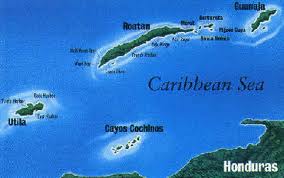
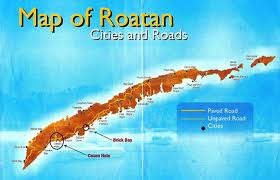
Roatán, located between the islands of Útila and Guanaja, is the largest of Honduras' Bay Islands.
The island was formerly known as Ruatan and Rattan. It is approximately 60 kilometres (37 mi) long, and less than 8 kilometres (5.0 mi) across at its widest point. The island consists of two municipalities (out of a total of four in the department):
- José Santos Guardiola in the east (named for the former president of Honduras) and
- Roatán (also including the Cayos Cochinos) further south in the west.
The most populous town of the island is Coxen Hole, capital of Roatán municipality, located in the southwest. Other important towns include French Harbour, West End, and Oak Ridge (the capital of José Santos Guardiola municipality).
The easternmost quarter of the island is separated by a channel through the mangroves that is 15 meters wide on the average. This section is called Helene, or Santa Elena in Spanish. Satellite islands at the eastern end are Morat, Barbaretta, and Pigeon Cay. Further west between French Harbour and Coxen Hole is Stamp Cay and Barefoot Cay. Known as Burial Key until 2001, Barefoot Cay now is privately owned and houses a luxury resort popular with celebrities. Starting in November, 2012, American Airlines will offer non-stop service to Roatan.[1]
[edit]Located near the Mesoamerican Barrier Reef, the largest barrier reef in the Caribbean Sea (second largest worldwide after Australia's Great Barrier Reef), Roatán has become an important cruise ship and scuba diving destination in Honduras. Tourism is its most important economic sector, though fishing is also an important source of income for islanders. Roatan is located within 50 minutes of LGS[clarification needed]. The island is served by the Juan Manuel Gálvez Roatán International Airport. Which includes direct flights from Atlanta and Houston via Delta and United airlines respectively, with other domestic connections for international flights arriving into mainland Honduran cities like the capital Tegucigalpa, San Pedro Sula and San Salvador. Roatán is also serviced by the Galaxy Wave express Catamaran ferry.
Location

[edit]History

The pre-Columbian indigenous peoples of the Bay Islands are believed to have been related to Paya, Maya, Lenca or Jicaque, which were the cultures present on the mainland. Christopher Columbus on his fourth voyage (1502–1504) came to the islands as he visited the neighboring Bay Island of Guanaja. Soon after the Spanish began raiding the islands for slave labor. More devastating for Native American communities was exposure to Eurasian infectious diseases to which they had no immunity, such as smallpox and measles. No indigenous people survived the consequent epidemics.
Throughout European colonial times, the Bay of Honduras attracted an array of individual settlers, pirates, traders and military forces, engaged in various economic activities and playing out political struggles between the European powers, chiefly Britain and Spain. Roatán and the other islands were used as frequent resting points for sea travelers. On several occasions, they were subject to military occupation.[2] In 1723/1724 an approximately 20-year-old-man from New England, Philip Ashton, managed to survive as acastaway on the island for sixteen months until he was rescued (see Edward E. Leslie,Desperate Journeys, Abandoned Souls, 1988, pp. 100–120).
In contesting with the Spanish for colonization of the Caribbean, the English occupied the Bay Islands on and off between 1550 and 1700. During this time, buccaneers found the vacated, mostly unprotected islands a haven for safe harbor and transport. English, French and Dutch pirates established settlements on the islands. They frequently raided Spanish cargo vessels carrying gold and other treasures from the New World to Spain.

In 1797, the British defeated the Black Carib, who had been supported by the French, in a battle for control of the Windward Caribbean island ofSt. Vincent. Weary of their resistance to British plans for sugar plantations, the British rounded up the St. Vincent Black Carib and deported them to Roatán. The majority of Black Carib migrated to Trujillo on mainland Honduras, but a portion remained to found the community of Punta Gordaon the northern coast of Roatán. The Black Carib, whose ancestry includes Arawak and African Maroons, remained in Punta Gorda, becoming the Bay Island's first permanent post-Columbian settlers.[citation needed] They also migrated from there to parts of the northern coast of Central America, becoming the foundation of the modern-day Garífuna culture.
The majority permanent population of Roatán originated from the Cayman Islands near Jamaica. They arrived in the 1830s shortly after Britain'sabolition of slavery in 1838. The changes in labor force disrupted the economic structure of Caymanian culture. Caymanians were largely a seafaring culture and were familiar with the area from turtle fishing and other activities. Former Caymanian slaveholders were among the first to settle in the seaside locations throughout primarily western Roatán. Former slaves also migrated from the Cayman Islands, in larger number than planters, during the late 1830s and 1840s. Altogether, the former Caymanians became the largest cultural group on the island.[2]
For a brief period in the 1850s, Britain declared the Bay Islands its colony. Within a decade the Crown ceded the territory formally back toHonduras. British colonists were sent though, and asked William Walker, a freebooter with a private army, to help end the crisis in 1860 by invading Honduras; he was captured upon landing inTrujillo and executed there.
In the latter half of the 19th century, the island populations grew steadily and established new settlements all over Roatán and the other islands. Settlers came from all over the world and played a part in shaping the cultural face of the island. Islanders started a fruit trade industry which became profitable. By the 1870s it was purchased by American interests, most notably the New Orleans and Bay Islands Fruit Company. Later companies, the Standard Fruit and United Fruit Companies became the foundation for modern-day fruit companies, the industry which gave Honduras the sobriquet "banana republic".
The 20th century saw continued population growth resulting in increasing economic changes, and environmental challenges. A population boom began with an influx of Spanish-speaking Mestizomigrants from the Honduran mainland. In the last decades they tripled the original resident population. Mestizo migrants settled primarily in the urban areas of Coxen Hole and Barrio Los Fuertes (near French Harbour). But in terms of population and economic influence, the mainlander influx was dwarfed by the overwhelming tourist presence in most recent years. Numerous American, Canadian, British, New Zealand, Australian and South African settlers and entrepreneurs engaged chiefly in the fishing industry, and later, provided the foundation for attracting the tourist trade.
In 1998, Roatán suffered some damage from Hurricane Mitch, temporarily paralyzing most commercial activity. The storm also broke the popular dive-wrecks "Aguila" and "Odyssey" into several pieces.
[edit]Demographics
At the 2001 Census the island had a population of 25,038.
[edit]Caracoles
The Caracol people are an English-speaking people who have been established in Northern Honduras (specifically, the Bay Islands) since the early 19th century. They are chiefly of European and British-Afro-Caribbean descent. Caracol is Spanish for "conch, snail or shell", and relates the people of the Bay Islands to their unique environment and their seafaring culture. In its current usage, the term caracol refers to all people born in the Bay Islands region, and their descendants. The term "caracol" has also been deemed offensive by native Islanders and the term is only used by Spanish-speaking "mainland" Hondurans who have a long standing rivalry with native Bay Islanders because of their differences in culture, language, beliefs and ideals. All native islanders regardless of race, creed or color prefer the term "Islanders" when being referred to. The region of the Bay Islands encompasses the three major islands of Roatán, Útila and Guanaja, the Hog Islands as well as the smaller islands or cays. These people are also called "Islanders," especially locally.
English is the first language of all native islanders regardless of race and Spanish is spoken second, whereas mainland Honduras is primarily Spanish speaking. It remains this way because of the islands past as a British colony as well as all islanders being the descendants of the British Isles. With the steady influx of mainland Hondurans migrating to the islands an increase in Spanish has arisen but because of the tourism and cruise ship industry that support the islands, English continues and will remain to be the first spoken and dominant language among all native island peoples. Over time the form of English spoken by the Caracol has changed. The language differs mostly in morphology but also in pronunciation and accent and, to a lesser extent, in syntax and vocabulary, from the English of the other British Caribbean colonies. Evidenced by the usage of the wide variety of old standard English terms and words that are used throughout the islands. They are similar enough to be mutually intelligible and understood throughout the entire Bay Islands. The language can also be learned, although it is not taught in the general sense, whilst the accent derived from the wide variety of expatriates living and working on the Islands from North America and Europe.
[edit]Environment
ROATA |
Roatán lies on the southern edge of the Mesoamerican Reef System, the second largest barrier reef in the world. Reef systems are very delicate and have experienced massive damage and degradation worldwide. On Roatán, unchecked tourism development and an increased population are putting a strain on its natural resources. Deforestation, run-off, poorly managed waste treatment, and pollution are the main threats to the terrestrial and marine environments.
The capital city of Coxen Hole underwent a major reconstruction between the years of 2003 to 2005 adding new black water and septic lines as well as fresh water lines to accommodate the growing business sector and population. These lines are used in conjunction with the new water treatment plant and a waste management plant that recycles waste which are adjacent to the Roatán International Airport.
Unfortunately, many of these lines were not hooked up to the main sewer system and raw sewage still flows directly into the ocean. This exact environmental restructuring is under way in the town of West End. The project has received much hesitation from residents in West End as the project has been poorly planned and executed.
Residents of West End are also being made to pay for much of the municipal project and face leans and levies against their properties if they are unable to pay. Construction of the sewerage system began in August 2011. Less than a month later, rainy season began. Every rain storm washes the clay and sediment from the construction zones directly into the ocean and onto the reef. This mixture of red clay and sediment is particularly detrimental to the health of the reef. Yet the Municipality has taken very few measures to lessen the damaging environmental impacts caused to the reef by the construction. The project's expected completion date is the end of 2012 or before the start of the following rain season which starts from the middle of October to the end of March. Though it is illegal to use plastic bags in the Bay Islands and is illegal for a business to bring in plastic bottles unless they remove them, the island and its reefs continue to be littered with plastics. The Roatán Marine Park was the main force behind reintroducing recycling to the island after a 3 year absence.
The Honduran government has worked with newer real estate developments such as Bella Bay Estates at Caribe Point to encourage ecologically sensitive design.[3]
[edit]Roatan Marine Park
The Roatán Marine Park (RMP) is a grassroots, community-based, non-profit organization located on Roatan. The organization was formed in January 2005 when a group of concerned dive operators and local businesses united in an effort to protect Roatan’s fragile coral reefs. Initially, the RMP's goal was to run a patrol program within the Sandy Bay-West End Marine Reserve (SBWEMR), to prevent over exploitation through unsustainable fishing practices. Over time, the organization expanded the scope of their environmental efforts through the addition of other programs to protect Roatan’s natural resources, including patrols and infrastructure, education, conservation and public awareness.
[edit]Conservation
All reef systems throughout the Bay Islands are protected by the local and central government with help from charitable donations and those on the front line. Through local donations to the Marine Park and the many causes along with a concerted effort from the resorts on the island weekly cleanups are undertaken to insure no metals or plastics litter the reef system and beaches as well as all major dive shops doing cleanups on most of their daily dives. There are still obstacles to be defeated but the Islander's and expatriates living on the islands have taken a united stand to conserve and educate.
[edit]Night Life
The main strip of the island is the coastal beach town of West End which also doubles as the island's main tourism hub and its center for diving. West End features a wide variety of bars and restaurants. Evenings in West End tend to move from North to South along the West End road with sunset drinks starting at Sundowners and The Landing, and late night drinks at The Blue Marlin and Nova Bar.
West Bay Community is a short drive away from West End either by car or water taxi and although it is known for the world famous West Bay Beach; it also features some of the larger and more well known resorts on Roatán as well as their own restaurants and bars open to the public.
[edit]Activities
Tourist activities in Roatán include diving, eco-tourism, adventure sports like ziplining, sport fishing, and glass-bottom boat tours. Boat charters are also available weekly from the West End & West Bay to Cayos Cochinos and Utila.www.westbaytours.com All major hotels as well as the smaller hotels in West End, West Bay, Oak Ridge, Sandy Bay and French Harbour all feature their own private dive shops for guests. There are two outer banks on the south side of the island that feature coral formations and species that are found nowhere else in the world. The best place to make bookings in The West End is at The Beach House Information Centre, located at the entrance of West End on Half Moon Bay.
Island tours via independent tour operators or transportation provided by the hotels is popular among visitors with local island drivers providing a narrated tour of the island. Most tours often pass through the historical island towns (including Punta Gorda which is the oldest settlement in the Bay Islands), the Carambola botanical gardens, and the Arch's iguana farm.
Our Staff
Our friendly and helpful staff will make sure you have a comfortable and enjoyable stay. This is our home, and it's our mission to help you feel at home too!
Customer Reviews
"This is sample review from a sample source." -- Sample Client, Location
"This is another sample review from another sample source." -- Sample Client, Location